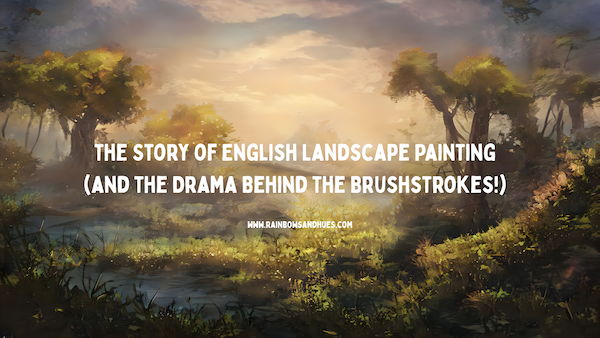
The tradition of English landscape painting captures the soul of Britain’s countryside. From rolling hills to dramatic coastlines, these works reflect both nature’s beauty and the nation’s cultural identity. This art form evolved over centuries, influenced by social changes, artistic movements, and the British love for the natural world.
Picture this: It’s 1802, and a young J.M.W. Turner has himself tied to a ship’s mast during a storm… all to paint the perfect tempest. That’s the kind of wild dedication that shaped England’s most breathtaking landscape art. Let’s take a stroll through this gorgeous tradition – with plenty of juicy backstories along the way!
The Origins of English Landscape Painting
Landscape painting began as a background element in portraits and historical scenes. During the 17th century, artists like Anthony van Dyck included detailed natural settings in their work. However, it wasn’t until the 18th century that landscapes became a respected genre.

The rise of the Grand Tour—a cultural trip across Europe—exposed British artists to classical landscapes. They returned with new ideas, blending foreign techniques with local scenery. Early pioneers like Richard Wilson painted idealized views of the British countryside, often inspired by Italian compositions.
Also Read: Batik Art: A Timeless Craft Bridging India and Indonesia
The Golden Age: Turner and Constable
The 19th century marked the peak of English landscape painting. Two giants dominated this era: J.M.W. Turner and John Constable.
Turner was a master of light and atmosphere. His works, such as The Fighting Temeraire, combined realism with emotional intensity. He used bold brushstrokes and luminous colors to depict storms, sunsets, and sea battles.
Constable, on the other hand, focused on rural life. His Hay Wain series celebrated the Suffolk countryside, where he grew up. Unlike Turner’s drama, Constable’s paintings felt peaceful and nostalgic. He sketched outdoors, capturing fleeting moments of light and weather.
Both artists shaped how Britain saw itself—Turner through grandeur, Constable through quiet beauty.
Also Read: The Fascinating World of Anime: A Complete Guide
The Influence of the Industrial Revolution
As cities expanded, landscapes took on new meaning. Painters like John Martin depicted apocalyptic factories, while others, including the Pre-Raphaelites, turned to medieval-style nature scenes. These works reflected anxieties about progress and a longing for simpler times.
The Romantic movement also played a role. Artists like Samuel Palmer painted mystical, moonlit fields, blending reality with imagination. This period showed nature as both a refuge and a spiritual force.
From Wallflower to Showstopper
Believe it or not, landscapes were once just fancy backdrops! In 17th century portraits, those dreamy countryside views? Merely decoration behind some stuffy aristocrat’s head. But then came the 18th century’s “Grand Tour” trend – basically Instagram travel for rich Brits.
Artist Richard Wilson returned from Italy so obsessed he started painting Welsh valleys to look like Tuscany. Critics scoffed: “Why paint boring Britain when you can copy the classics?” But Wilson persisted, accidentally inventing a whole new art genre.
Also Read: Five Tips To Click Better Photographs On Your Mobile
Turner vs. Constable: The Original Art Rivalry
Move over, Marvel heroes – Victorian England had its own epic showdown:
J.M.W. Turner – The rockstar who:
• Used his fingers to smudge paint (scandalous!)
• Sold paintings unfinished, claiming “atmosphere is more important than details”
• Once painted a fire so realistically, viewers ran for water buckets
John Constable – The countryside romantic who:
• Carried his paintbox through Suffolk like a picnic basket
• Made clouds the real protagonists of his works
• Got revenge on critics by mixing sand into his paints for extra texture
Fun fact: When Constable’s “Hay Wain” debuted in Paris, French artists gasped – his loose brushwork inspired the Impressionists!
Also Read: Spotlight: Claude Monet
Nature Gets Political
As smokestacks invaded the countryside, artists fought back with brushes:
• John Martin painted factories like biblical plagues (his “Pandemonium” looks like Mordor on a bad day)
• The Pre-Raphaelites created hyper-detailed nature scenes – some took months to finish a single leaf!
• Samuel Palmer went full mystic, painting Kent villages under spooky moonlight (rumor says he worked by candlelight wearing a monk’s robe)
Try This at Home: Spot the Tricks!
Next time you see pic of an English landscape, play detective:
Cloud Drama = Probably Constable (he kept a “cloud journal” with scientific notes)
Golden Glow = Likely Turner (he used experimental varnishes that are now cracking)
Sheep Too Perfect = Might be Gainsborough (he reused the same sheep sketch for decades!)
Techniques and Styles
English landscape painters used distinct methods:
- Plain air painting: Sketching outdoors to capture natural light.
- Watercolor: Popular for its portability and spontaneity.
- Oil painting: Preferred for detailed, large-scale works.
Compositions often featured:
- Pastoral scenes: Farms, rivers, and villages.
- Sublime landscapes: Mountains and storms evoking awe.
- Picturesque views: Balanced, harmonious nature.
Legacy and Modern Interpretations
The tradition continues today. Contemporary artists like David Hockney reimagine landscapes with vibrant colors and digital tools. Meanwhile, exhibitions of Turner and Constable still draw crowds, proving their lasting appeal.
English landscape painting also inspired conservation efforts. The National Trust, founded in 1895, protects many sites depicted in these works. Art helped people value—and preserve—their environment.
Also Read: Incorporating Dried Flowers in Resin Art: A Guide
Why It Matters
These paintings are more than pretty scenes. They reveal Britain’s history, emotions, and relationship with nature. From Constable’s meadows to Turner’s tempests, they invite us to see the world differently.
Whether you’re an art lover or a nature enthusiast, English landscapes offer timeless inspiration. They remind us to pause, observe, and cherish the beauty around us.
Also Read: Aipan Art: Preserving Heritage Through Patterns and Colors
***
Hop over to www.rainbowsandhues.com to explore exciting offers on arts & craft supplies on our website!
Follow @rainbowsandhues on Instagram to get regular information on new products and deals!