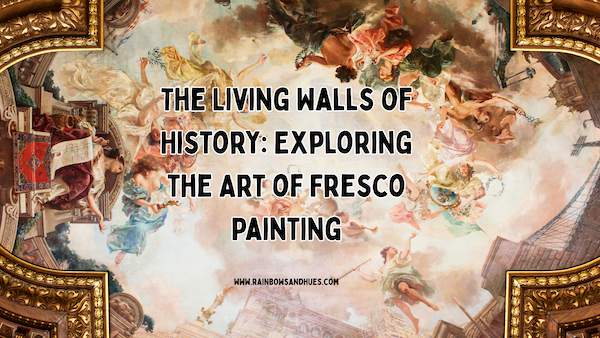
Fresco painting is not just an art form; it is a method that has preserved the stories, beliefs, and aesthetics of ancient civilizations across continents. Unlike oil or acrylics applied to canvas, frescoes are painted directly onto walls. Their charm lies in their permanence—frescoes become part of the architecture itself.
What is Fresco Painting?
Fresco, from the Italian word affresco meaning “fresh,” refers to a mural painting technique. The process involves applying water-based pigments onto freshly laid lime plaster. As the wall dries, the paint fuses with the plaster, making the image an integral part of the surface. This method ensures the durability of the artwork for centuries.
Also Read: Back to School Stationery Needs: A Comprehensive Guide
There are two main types of fresco:
- Buon fresco (true fresco): Pigment is applied to wet lime plaster. This is the most durable form.
- Fresco secco (dry fresco): Pigment is applied to dry plaster using a binding medium. It is less durable but allows more detailing.
Origins and Historical Roots
Fresco painting dates back to at least 1500 BCE. The Minoans of ancient Crete created vibrant frescoes that still survive in the Palace of Knossos. Similar techniques were used in ancient Egypt and Mycenaean Greece.
In India, frescoes can be traced back to the Ajanta Caves (2nd century BCE to 6th century CE). These Buddhist cave temples house frescoes that depict scenes from the life of the Buddha, mythology, and daily life.
However, the golden age of fresco painting flourished during the Italian Renaissance. Artists like Giotto, Michelangelo, and Raphael used this medium to decorate churches, chapels, and palaces.
Techniques and Materials
Creating a fresco requires a great deal of planning and skill. The process starts with preparing the wall surface using layers of rough plaster. Once this layer dries, a final thin coat of fine wet lime plaster, called intonaco, is applied.
Also Read: Incorporating Dried Flowers in Resin Art: A Guide
The artist must work quickly and precisely. Once the plaster dries, no changes can be made. This is why only a small section, known as a giornata (Italian for “a day’s work”), is painted at a time. The number of giornate in a fresco indicates how many days it took to complete it.
Pigments used are usually natural minerals. These get absorbed into the plaster, giving frescoes their signature matte and earthy finish.
Notable Fresco Artists
- Giotto di Bondone (Italy): Often regarded as the father of European fresco painting. His work in the Scrovegni Chapel (Padua) set the tone for Renaissance art.
- Michelangelo (Italy): His frescoes on the ceiling of the Sistine Chapel in Vatican City are iconic.
- Raja Ravi Varma (India): Though more famous for his oil paintings, Varma also experimented with frescoes during his career.
- The Unknown Artists of Ajanta and Ellora (India): These monks and artisans created masterpieces that still evoke awe and admiration.
Global Influence
Frescoes are not limited to Europe and India. The Mayans and Aztecs in Central America used similar techniques to decorate temples and palaces. In Tibet and Bhutan, monasteries house elaborate frescoes depicting deities, mandalas, and mythological narratives.
In modern times, Mexican muralists like Diego Rivera revived the tradition to depict social and political themes on public buildings.
Lesser-Known Facts
- Frescoes can be restored but not truly replicated. Since the pigment binds to wet plaster, replicating the exact hues and texture is nearly impossible.
- Some of the pigments used in frescoes, like lapis lazuli for blue, were more expensive than gold.
- Fresco painting was considered a divine task in some cultures, believed to invite blessings into the space it adorned.
Contemporary Relevance
While traditional frescoes are rare today due to the complexity and time involved, the method has inspired contemporary muralists and interior decorators. Modern technologies allow the creation of faux frescoes, imitating the aesthetic with more flexibility.
Also Read: A Comprehensive Guide to Chalk Paints
Conservation efforts are also underway globally. Institutions like the Archaeological Survey of India, UNESCO, and the Vatican Museum continue to preserve and restore historic frescoes.
How to Start Learning Fresco
If you’re curious to try your hand at this style of painting, begin with understanding lime plaster preparation. You’ll need:
- Slaked lime
- Fine sand
- Natural pigments
- Brushes with natural bristles
Practice on a small surface first. Remember, it requires speed, precision, and patience. Many art schools offer workshops that teach this technique. Visiting fresco-rich sites like Florence, Ajanta, or Mexico City can also deepen your appreciation.
Notable Artists and Artisans
Italy – Renaissance and Beyond
- Giotto di Bondone
Work: Scrovegni (Arena) Chapel, Padua
Note: Considered the father of Renaissance fresco. Introduced emotional realism. - Michelangelo Buonarroti
Work: Sistine Chapel Ceiling & The Last Judgment, Vatican
Note: His ceiling work changed the trajectory of Western art. - Raphael (Raffaello Sanzio)
Work: The School of Athens, Vatican Rooms
Note: Blended classical philosophy and Renaissance humanism in fresco. - Masaccio
Work: Brancacci Chapel, Florence
Note: Used linear perspective in this style of painting to show spatial depth. - Piero della Francesca
Work: The Legend of the True Cross, Arezzo
Note: Master of geometric harmony and light in fresco.
India – Ancient to Medieval
- Anonymous Ajanta Cave Painters (2nd century BCE – 6th century CE)
Work: Ajanta Caves, Maharashtra
Note: Created murals depicting Jataka tales and daily life using natural pigments. - Ellora Cave Artisans (6th–10th century CE)
Work: Kailasa Temple & Buddhist Monasteries, Maharashtra
Note: Continued the fresco tradition with mythological themes. - Bagh Cave Painters (6th–7th century CE)
Work: Bagh Caves, Madhya Pradesh
Note: Showcased fine detailing and bold linework similar to Ajanta style. - Deccan & Vijayanagara Frescoes (14th–16th century CE)
Work: Lepakshi Temple (Andhra Pradesh)
Note: Featured vivid depictions of Hindu deities and epics in fresco technique. - Rajasthan & Bundelkhand Temples
Work: Various temple interiors
Note: Continued using dry fresco (secco) with bold colors and stylized forms.
Mexico – 20th Century Revival
- Diego Rivera
Work: National Palace & Ministry of Education, Mexico City
Note: Reinvigorated fresco art with socio-political themes. - José Clemente Orozco
Work: Hospicio Cabañas, Guadalajara
Note: Employed dramatic expressionism in large-scale fresco murals. - David Alfaro Siqueiros
Work: Polyforum Cultural Siqueiros
Note: Innovated with materials and techniques while staying rooted in fresco.
Egypt – Antiquity
- Anonymous Egyptian Tomb Artists
Work: Tomb of Nebamun, Thebes (Luxor Museum)
Note: Used early fresco secco to narrate afterlife beliefs.
Others of Note
- Paolo Uccello (Italy): Combined fresco with mathematical perspective.
- Fra Angelico (Italy): Created gentle religious frescoes for monastic spaces.
- Giulio Romano (Italy): Student of Raphael; introduced Mannerist elements in fresco.
- Benedetto Bonfigli (Italy): Early master of fresco in Perugia.
Conclusion
Fresco painting is more than a technique—it’s a window into time. Each stroke immortalizes a story on stone, blending human creativity with architecture. From ancient caves to cathedral ceilings, frescoes remind us that art can be timeless, quite literally built into the walls around us.
Also Read: Lippan Art: A Unique Blend of Tradition and Craftsmanship
***
Hop over to www.rainbowsandhues.com to explore exciting offers on arts & craft supplies on our website!
Follow @rainbowsandhues on Instagram to get regular information on new products and deals!