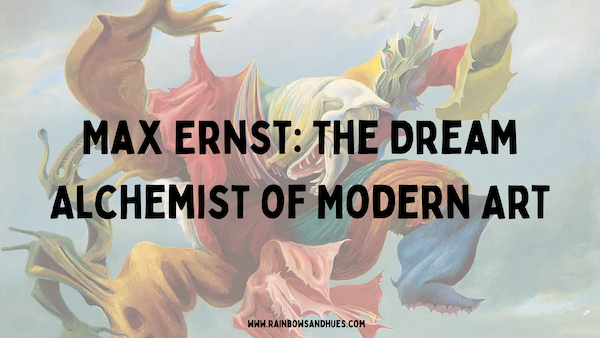
Max Ernst was more than a painter. He was a visionary who refused to follow rules and instead invented his own world. Born on April 2, 1891, in Brühl, Germany, Ernst became one of the most important figures in the Dada and Surrealist movements. His art was bold, strange, often unsettling, and deeply imaginative. He worked across many mediums—painting, sculpture, collage, and even poetry—bringing to each a sense of magic, rebellion, and the subconscious.
Early Life and Influences
Ernst grew up in a Catholic household. His father was an amateur painter and taught at a school for the deaf. Young Max was exposed early to both art and strict discipline. However, it was during his university years at the University of Bonn that he began to explore philosophy, psychology, and literature. He never received formal art training, but that didn’t hold him back.
Also Read: Alcohol Ink Art: An Exhaustive Guide
In 1913, he met August Macke and became connected to the German Expressionist group Der Blaue Reiter. This connection helped Ernst move into the world of avant-garde art. The outbreak of World War I interrupted his early artistic journey. He served in the German army but returned deeply changed. The trauma of war would later surface in his work through fragmented images and dream-like themes.
The Dada Years
By 1919, Ernst had co-founded the Cologne Dada group alongside Johannes Theodor Baargeld. Dada was not just an art movement—it was a form of protest. Dada artists rejected reason and logic, focusing instead on chaos, absurdity, and the irrational. Ernst embraced this freedom. He began creating photo collages that mixed scientific illustrations, catalog images, and odd juxtapositions.
His 1920 work The Hat Makes the Man is a perfect example. It consists of men’s hats arranged in a bizarre totem-pole fashion. The piece pokes fun at identity, masculinity, and social norms.
Surrealism and the Move to Paris
In 1922, Ernst moved to Paris and became deeply involved with Surrealism, a movement founded by André Breton. Surrealism aimed to unlock the unconscious mind. It welcomed dreams, hallucinations, and irrational thoughts. Ernst quickly became a leading figure. He was known for inventing new techniques that allowed the subconscious to speak.
Also Read: Pattachitra: A Window into Ancient Indian Folk Art
One of his major contributions was frottage, a method of rubbing pencil or charcoal over textured surfaces. This would reveal patterns that Ernst developed into creatures, landscapes, or abstract forms. He also invented grattage, where he scraped layers of paint off a canvas to expose new textures and shapes.
His painting The Elephant Celebes (1921) is often cited as a surrealist masterpiece. The image blends mechanical parts with organic forms to create a dreamscape that feels familiar but impossible. Another landmark work is Europe After the Rain II (1940–42), a bleak, war-torn landscape that captures the horror of World War II through surreal imagery.
Personal Life and Relationships
Max Ernst’s personal life was as unconventional as his art. He married several times, including to the well-known art collector and patron Peggy Guggenheim. He also had close relationships with other artists like Leonora Carrington, a fellow surrealist. Carrington and Ernst shared a deep interest in mysticism and mythology, which influenced their respective works.
His time in the United States during World War II was especially productive. Along with Marcel Duchamp and other exiled artists, Ernst contributed to the American art scene. He inspired many young painters who later became central to Abstract Expressionism.
Return to Europe and Later Years
After the war, Ernst returned to Europe and eventually settled in France. In 1954, he won the Grand Prize for Painting at the Venice Biennale. Despite being controversial earlier in his career, Ernst was now celebrated. He continued to paint, sculpt, and experiment well into his 80s.
Also Read: Ray, Tagore, and Dali: Artists of May
One of his most striking later works is the sculpture Capricorne (1948). It blends mythological themes with Ernst’s characteristic surreal forms. Standing like guardians of an ancient dream world, the figures suggest a timeless, enigmatic presence.
Legacy and Influence
Max Ernst died on April 1, 1976, just one day before his 85th birthday. However, his legacy lives on. He gave the art world new ways to see, feel, and interpret the unseen. His inventive methods—collage, frottage, grattage, and decalcomania—influenced generations of artists. He bridged the gap between chaos and control, allowing chance and technique to dance together.
Ernst’s work continues to be exhibited around the world. Museums such as the Museum of Modern Art in New York, Centre Pompidou in Paris, and Tate Modern in London hold many of his iconic pieces.
Max Ernst was more than a painter of dreams. He was a builder of worlds that made us question reality, truth, and meaning. Through his relentless creativity and refusal to be boxed in, he redefined what art could be. Whether it’s a collage of clock parts or a canvas filled with strange textures, Ernst reminds us that art is not just something we see. It’s something we feel—and sometimes, something we can’t explain.
***
Hop over to our website www.rainbowsandhues.com to buy premium quality paintbrushes and colors! Follow @rainbowsandhues on Instagram to get regular information on new products and deals!